
Tissue made from 100% virgin pulp is produced from fresh wood fibers that have not previously been used to make paper. These longer, cleaner fibers help tissue products deliver a better balance of softness, absorbency, strength, and consistency. For toilet paper, kitchen towels, facial tissues, and commercial tissue products, that balance affects how the product feels, performs, and holds up during use.
For you as a buyer, distributor, hotel, restaurant, healthcare provider, or retailer, virgin pulp can make a practical difference in everyday settings. It can provide a smoother feel against the skin, better liquid absorption during cleaning, and more reliable performance from one roll or sheet to the next. Yumero uses 100% virgin pulp to manufacture tissue products designed for dependable quality in both household and professional environments.
Key Takeaways
-
Virgin pulp comes from fresh wood fibers that have not previously been processed into paper.
-
Longer virgin fibers support softness, absorbency, sheet strength, and better product consistency.
-
Virgin pulp is well suited to toilet paper, facial tissues, kitchen towels, and commercial tissue products.
-
Recycled pulp can be a suitable choice for some applications, but fiber quality may vary after repeated processing.
-
Yumero manufactures tissue products with a focus on reliable performance, hygiene, and end-use requirements.
What Is Virgin Pulp?
Virgin pulp is the fiber material produced from wood that has not previously been made into paper or tissue. During manufacturing, wood is processed to separate its cellulose fibers. These fibers are then cleaned, refined, formed into a paper web, pressed, and dried to create tissue sheets.
Unlike recycled pulp, virgin pulp has not passed through earlier paper-production and recycling cycles. The fibers therefore retain much of their original length and structure. This gives manufacturers greater control over the characteristics of the finished tissue, including softness, tensile strength, absorbency, and sheet formation.
The term 100% virgin pulp means that the paper fibers used in the product come entirely from fresh pulp rather than a blend containing recycled fiber. However, responsible sourcing remains important. A tissue manufacturer should also pay attention to fiber origin, forestry practices, supplier controls, and applicable environmental standards.
Virgin Pulp Compared with Recycled Pulp
Both virgin and recycled pulp can be used to manufacture paper products, but they behave differently during processing. Recycling shortens and weakens fibers over time. Each recycling cycle can reduce the fiber’s ability to form a strong, flexible sheet. Recycled pulp may also require additional cleaning and processing to remove inks, coatings, and other materials from the original paper.
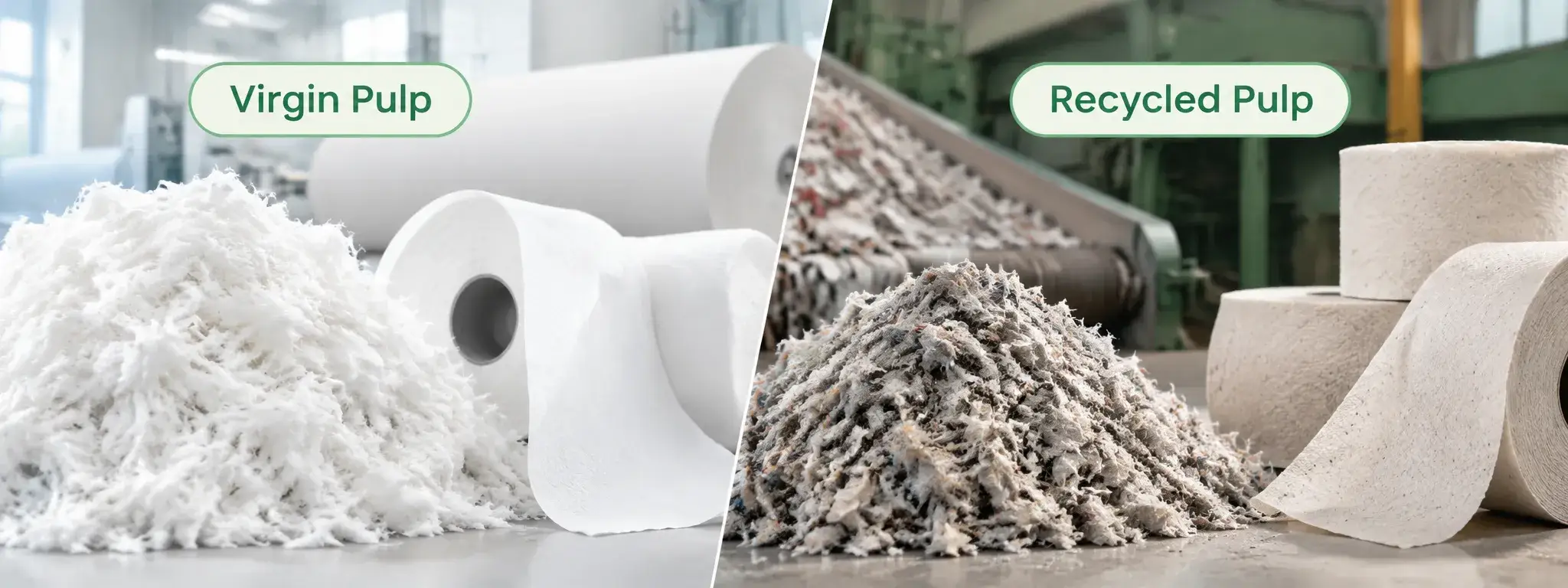
Virgin pulp starts with longer fibers and a more predictable raw-material profile. This does not automatically make every virgin-pulp tissue product superior; manufacturing method, paper structure, embossing, ply design, and converting quality also matter. Still, virgin pulp gives the manufacturer a strong foundation for producing tissue with stable performance.
| Factor | 100% Virgin Pulp | Recycled Pulp |
|---|---|---|
| Fiber condition | Fresh and generally longer | May be shorter after reprocessing |
| Softness potential | High, depending on refining and manufacturing | Varies by fiber source and treatment |
| Sheet strength | Consistent when properly engineered | Can vary between batches |
| Absorbency | Strong performance potential | Depends on fiber quality and formulation |
| Raw material control | More predictable | Depends on collected paper streams |
| Typical use | Premium, hygiene-sensitive, and high-performance products | Applications where recycled content is a priority |
The Advantages Of Virgin Pulp In Tissue Production
Virgin pulp matters because tissue has to perform under direct and frequent use. You may need a toilet roll that feels comfortable, a facial tissue that is gentle on the skin, or a kitchen towel that absorbs liquid without falling apart. Virgin fiber helps manufacturers engineer these different products with a controlled balance of softness, strength, and absorbency.
The final result depends on more than the pulp alone. Fiber selection must work with refining, creping, drying, ply construction, embossing, perforation, and converting. When these elements are properly matched, virgin pulp can support a tissue product that feels consistent and performs reliably in the intended setting.
1. Enhanced Softness and Skin Comfort
Virgin pulp can help create a softer tissue surface because its fibers retain their length and flexibility. During production, the fibers can be refined and formed into a low-density sheet that feels smoother and more comfortable. This is especially relevant for facial tissues and toilet paper, which come into close contact with sensitive skin.
Softness is not determined by fiber type alone. The tissue’s basis weight, creping level, embossing pattern, ply count, and moisture content also influence how it feels. A well-designed virgin-pulp tissue can provide softness without becoming so delicate that it tears during normal use.
For you as an end user, the benefit is straightforward: the tissue feels less harsh during repeated use. In hotels, offices, clinics, and other facilities, this comfort can contribute to a better user experience while supporting a consistent product standard across washrooms and guest areas.
2. Strong Absorbency for Daily Use
Absorbency describes how quickly and effectively tissue takes in liquid. Virgin fibers can create a stable network of spaces within the sheet, allowing liquid to enter and spread through the paper structure. This is useful when you use kitchen towels to handle spills, dry hands, or wipe work surfaces.
A tissue’s absorption performance also depends on sheet density, creping, embossing, air space, and the number of plies. A thicker sheet is not always the most absorbent, and a highly absorbent sheet still needs adequate strength when wet. Manufacturers must balance these properties according to the product’s purpose.
Yumero can develop tissue formats for different use scenarios, from light household wiping to more demanding food-service and commercial cleaning applications. Product specifications should be matched to the task rather than selected only by appearance or roll size.
3. Better Strength and Tear Resistance
Longer fibers can interlock more effectively during sheet formation, helping tissue resist tearing. This is important when you pull toilet paper from a roll, use facial tissue, or lift a wet kitchen towel from a countertop. Strength gives the sheet enough structure to remain usable without making it feel rough or overly rigid.
Wet strength is a separate consideration from dry strength. Kitchen towels and hand towels may need to maintain their structure after absorbing water, while toilet paper is generally designed to disperse more readily after flushing. A responsible manufacturer should design each product around its intended use instead of applying the same strength profile to every tissue category.
Virgin pulp gives manufacturers more control over this balance. Through fiber selection and paper-machine adjustments, they can produce a sheet that offers the required durability while preserving softness and a comfortable hand feel.
Why Virgin Pulp Is Important For Different Tissue Products
The right tissue specification depends on the environment in which you use it. A facial tissue must prioritize skin comfort, while a kitchen towel must manage liquid and resist tearing. Toilet paper must balance softness, strength, and appropriate dispersibility. Virgin pulp can support each of these requirements when the product is properly engineered.
1. Toilet Paper
Toilet paper needs to feel soft, provide sufficient strength during use, and separate appropriately after disposal. Virgin pulp can help create a smooth, comfortable sheet with dependable dry performance. Ply construction and embossing can then be adjusted to improve bulk, softness, and visual presentation.
For hotels, offices, restaurants, and residential use, product selection should also consider roll dimensions, sheet count, dispenser compatibility, and storage conditions. A premium toilet roll is not defined by pulp alone; it is the result of raw-material control and converting quality working together.
2. Kitchen Towels
Kitchen towels need a different performance profile. When you wipe a countertop, absorb a spill, or dry utensils, the sheet must take in liquid and remain intact during handling. Virgin pulp can support a stronger fiber network, while creping and embossing can improve the sheet’s capacity to hold and distribute liquid.
Commercial kitchens and food-service businesses may require larger rolls, higher sheet counts, stronger wet performance, or dispenser-ready formats. Yumero can manufacture tissue solutions based on practical operating requirements, including roll size, ply, packaging, and application.
3. Facial Tissues
Facial tissues are used directly on the face, so softness and surface comfort are central requirements. Virgin pulp can help produce a smooth sheet with a gentle feel, particularly when combined with suitable refining and converting methods.
You should also consider facial tissue dimensions, ply count, lotion or additive requirements, box design, and dispensing performance. For hospitality, healthcare, retail, and office environments, a consistent facial tissue specification helps maintain a reliable standard for users.
4. Commercial and Away-from-Home Tissue
Away-from-home tissue products are used in places with frequent traffic, including offices, shopping centers, schools, hotels, hospitals, restaurants, and public facilities. These products need to perform consistently while fitting the dispenser and purchasing system used by the facility.
Virgin pulp may be particularly useful when the application requires a combination of comfort, strength, absorbency, and controlled appearance. Buyers should evaluate the product using measurable criteria such as sheet dimensions, basis weight, ply, roll length, tensile strength, absorbency, packaging, and delivery reliability.
Is 100% Virgin Pulp More Hygienic?
Virgin pulp is a clean, controlled raw material, but the phrase “100% virgin pulp” should not be treated as a complete hygiene guarantee by itself. Hygiene depends on the entire production chain, including raw-material handling, water and air controls, equipment sanitation, employee practices, packaging, warehousing, and transportation.
The advantage of virgin pulp is that it has not previously been part of a used paper product. It can therefore help reduce the variability associated with recovered paper streams. Manufacturers still need documented quality controls and appropriate testing to ensure that the finished tissue meets applicable requirements.
When you are evaluating a tissue supplier, ask about manufacturing controls, product specifications, packaging integrity, quality testing, and traceability. A reliable supplier should be able to explain how it controls quality from pulp receipt through finished-product shipment.
Conclusion
Virgin pulp matters because it gives tissue manufacturers a controlled starting material with long, flexible fibers. When processed correctly, those fibers can improve softness, absorbency, strength, and consistency across toilet paper, kitchen towels, facial tissues, and commercial tissue products.
Yumero uses 100% virgin pulp to manufacture tissue products for buyers who need reliable performance and consistent supply. Contact Yumero to discuss product samples, private-label manufacturing, wholesale orders, or a tissue specification designed for your market and application.
Frequently Asked Questions
Is virgin pulp better than recycled pulp for toilet paper?
Virgin pulp often provides greater softness, strength, and consistency. Recycled pulp can be suitable when recycled content is the main priority, but performance depends on the quality and processing of the recovered fibers.
Is 100% virgin pulp safe for sensitive skin?
Virgin pulp can produce a smooth, soft tissue suitable for sensitive skin. Skin comfort also depends on the product’s surface, additives, fragrance, refining, and manufacturing quality. If sensitivity is a concern, choose fragrance-free tissue and review the product specification.
Does virgin pulp make tissue more absorbent?
Virgin pulp can support strong absorbency because its fibers help form a stable sheet structure with useful air space. The final absorbency also depends on creping, embossing, ply, basis weight, and the production process.
Why does toilet paper tear easily?
Toilet paper may tear because of low basis weight, a lightweight construction, insufficient fiber bonding, moisture, or the way it is dispensed. A higher-quality product usually balances softness with enough strength for normal use.
What is the difference between virgin pulp and wood pulp?
Wood pulp is a general term for pulp made from wood. Virgin pulp is wood pulp made from fresh fiber that has not previously been used in paper or tissue production.
Is virgin pulp environmentally friendly?
Virgin pulp is not automatically environmentally friendly. Its environmental profile depends on forest management, sourcing, energy use, water management, manufacturing efficiency, packaging, and end-of-life handling. Responsible sourcing and documented production controls are important.
Can Yumero manufacture private-label tissue products?
Yumero can discuss private-label and OEM tissue manufacturing based on product type, dimensions, ply, packaging, order volume, and market requirements. Contact the factory with your specifications for a suitable production plan.